
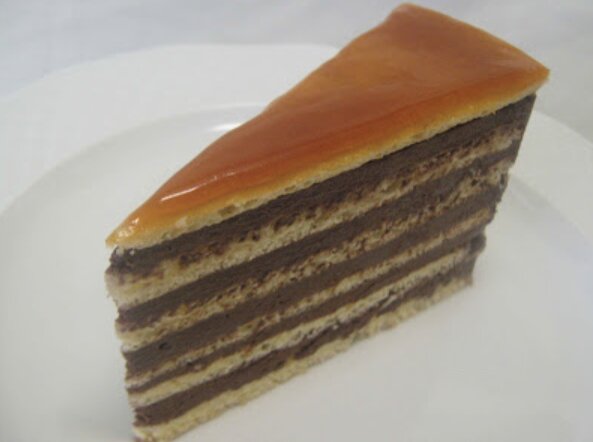
Some of the greatest culinary discoveries weren’t planned at all. The kind of happy accident that, in the moment, probably felt like a disaster — and in retrospect, changed everything. The story behind Hungary’s most celebrated dessert, the Dobos Cake, follows exactly that pattern. A young apprentice reached for the wrong ingredient, a master pastry chef chose curiosity over frustration, and somewhere in that exchange, one of the most iconic cakes in European history was born.
At least, that’s how the legend goes. And even if it’s been polished with the passage of time, the truth underneath it is real enough: the Dobos Cake exists because someone refused to throw away a mistake.
Dobos cake
The Wrong Ingredient at the Right Moment
The story begins with a simple error. A pastry apprentice in nineteenth-century Budapest was preparing ingredients when he reached for sugar instead of salt and added it to softened butter. Easy enough to do, and under most circumstances, the kind of slip that ends with something scraped into the bin. But the apprentice’s employer was József C. Dobos — and Dobos wasn’t the type to waste either ingredients or opportunities.
Instead of tossing the sweetened butter, he started experimenting. What he discovered through that process was buttercream: smooth, stable, and unlike anything else being used in confectionery at the time. In an era when cooked creams and whipped fillings dominated the pastry world, buttercream was genuinely new. It would go on to become a foundational element of modern cake-making. Not bad for a kitchen mistake.
Who Was József Dobos?
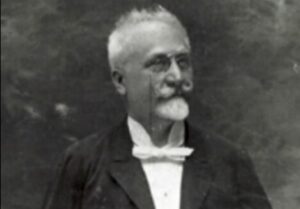
József C. Dobos
Among the greatest pastry chefs of the 1800s, József Dobos stood in a league of his own, earning recognition far beyond the borders of Hungary alone. His reputation spread throughout the entire Austro-Hungarian Empire, making him a household name across the region. The Dobos family had been crafting confections for multiple generations, and József carried on this proud tradition with remarkable skill and ambition. Much like those who came before him, he possessed a fearless willingness to experiment and innovate. He remained deeply rooted in the bold and distinctive tastes of Hungarian cuisine, yet he was not hesitant to incorporate the refined and elegant techniques of French cooking into his creations, resulting in a truly unique culinary style.
A Practical Solution to a Real Problem
To understand why the Dobos Cake was such a breakthrough, you have to understand the world Dobos was working in. Refrigeration as we know it didn’t exist in the 1880s. The creams and fillings that filled most confections of the period were delicious but deeply perishable — fine if you were eating them on the spot, impractical for anything else. Dobos saw this as a problem worth solving.
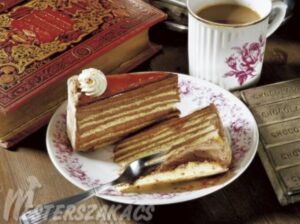
Dobos cake, coffee and a book: a perfect combination
His answer was elegant in its simplicity. The cake he developed featured five thin layers of delicate sponge, sandwiched together with rich chocolate buttercream, and finished on top with a crisp, glossy layer of caramel. Every element served a purpose. The buttercream was stable. The caramel topping sealed the cake and gave it structure. The whole thing could travel, hold up over time, and still taste exceptional when it arrived.
This was a deliberate departure from the fashion of the day. The most admired cakes of the late nineteenth century were architectural exercises — towering, ornately decorated creations more concerned with spectacle than flavor or longevity. Dobos was doing something different. He was thinking about function as much as taste, and the result was a cake that looked understated by comparison but outperformed everything around it.
A Royal Debut and a Continental Reputation
The Dobos Cake made its public debut in 1885 at the first Budapest National General Exhibition — and it didn’t debut quietly. Among the guests who tasted it that day were Queen Elisabeth, known to history as Sissi, and Emperor Franz Joseph I. Their approval set the tone for everything that followed.
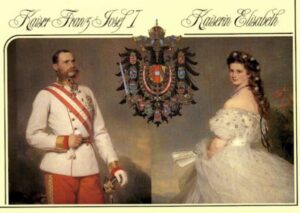
Franz Joseph and Sissi
Word spread fast. Within a relatively short time, the cake had developed a following that extended well beyond Hungary’s borders. In the fashionable salons of Vienna, Berlin, and Paris, ordering directly from the Budapest master had become a mark of sophistication. Dobos, ever the pragmatist, designed a custom wooden transport box to ensure his cakes survived the journey intact — an early and rather charming example of premium packaging solving a logistical problem.
The Secret, the Obsession, and the Gift
Success of this magnitude inevitably attracted imitators. Pastry chefs across Europe attempted to reverse-engineer the recipe, and most fell short. Dobos guarded the formula carefully, and his staff was equally tight-lipped. One confectioner, József Riedl, came close — but “close” wasn’t the original.
Then in 1906, Dobos did something unexpected. He handed the recipe over voluntarily to the Budapest Confectioners and Gingerbread Makers’ Association, making it freely available to any professional who wanted it. It was an act of remarkable generosity, and it’s largely the reason the authentic Dobos Cake survived as a living tradition rather than disappearing with its creator.
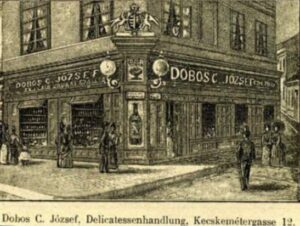
Dobos confectionery on Kecskeméti Street
Dobos himself was more than a talented pastry chef. His delicatessen on Kecskeméti Street was one of the most celebrated establishments in Budapest, and the cookbook he authored holds a significant place in Hungarian culinary history — the first serious modern work on the subject in Hungarian, filled with recipes that had never before been committed to print.
A Protected Legacy
The cake has evolved considerably since 1885. Today, more than a hundred variations exist, each with its own interpretation of the original concept. But the authentic Dobos Cake earned official legal protection in 2017, which established clear standards: to carry the name, a cake must be circular, must contain exactly five sponge layers alternating with chocolate buttercream, and must be finished with the signature caramel top. Everything else is an imitation — sometimes a good one, but an imitation nonetheless.
There’s something quietly moving about a dessert earning that kind of protection. It acknowledges that the Dobos Cake isn’t just a recipe — it’s a piece of cultural identity, a connection to a particular time and place, and the exceptional person who created it. From a pastry apprentice’s careless reach into the sugar bowl, to royal tables, to protected gastronomic heritage: not many accidents in history have landed quite so well.
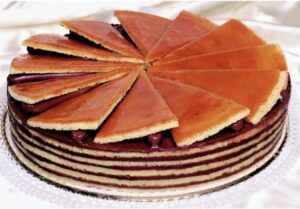
Dobos cake has a legal protection
The Original Recipe
“You need 6 sponge layers for a 22 cm cake. For the sponge layers: you mix 6 egg yolks well with 3 lat (lat=half an ounce, 50 g) powdered sugar, whip up 6 egg whites to a hard mousse with 3 lat (50 g) powdered sugar, then mix the egg yolks with 6 lat (100 g) flour and 2 lat (35 g) melted butter. For the cream you need: 4 eggs, 12 lat (200 g) powdered sugar, 14 lat (235 g) butter, 2 lat (35 g) cocoa powder, 1 lat (17 g) vanilla sugar, 2 lat (35 g) cocoa butter and 1 bar (200 g) of chocolate. You beat the eggs with the sugar over gas until it heats up, you take it off the stove and mix it until it cools down. You cream the butter, add the vanilla sugar, the melted cocoa butter and the slightly heated, soft chocolate. Then you mix it with the cooled eggy mousse, fill in five sponge layers, pour caramelised sugar over the sixth layer and cut it into 20 pieces.”
