
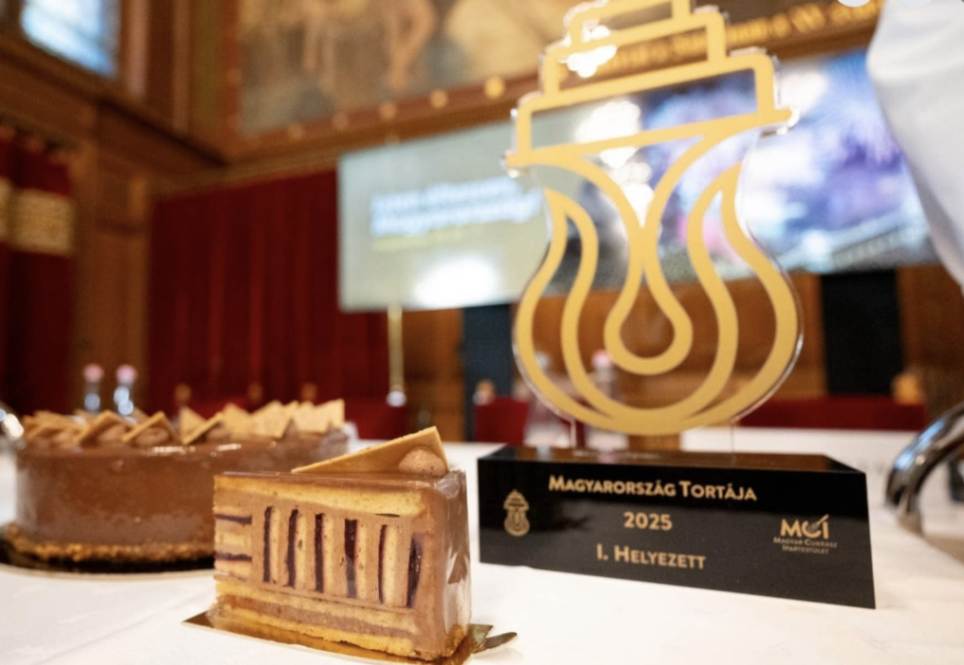
There’s a certain magic that happens when flour meets sugar, or when dough rises to perfection. In Hungary, this magic isn’t just celebrated, it’s elevated to national importance. Last Thursday, beneath the grand dome of Budapest’s Parliament building, the country’s most talented bakers and confectioners gathered for a ceremony that would crown the new royalty of Hungarian gastronomy: Cake and Bread of Hungary 2025.
A Modern Classic Takes the Crown
József C. Dobos probably never imagined that 140 years after he created his revolutionary caramel-topped cake, pastry chefs would still be drawing inspiration from his work. Yet here we are in 2024, with a bold reinterpretation claiming the prestigious Cake of Hungary 2025 title.
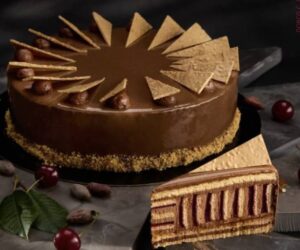
“Stylistic Exercise”: the Cake of Hungary of 2025
“DCJ Stílusgyakorlat” (or “Stylistic Exercise”) emerged victorious from the skilled hands of Kézműves Cukrászda’s team in Gyula. This southern Hungarian town, renowned for its thermal baths and historic castle, now has another claim to fame: housing the bakery that created Hungary’s national cake for the upcoming year.
What makes this creation special isn’t just its taste, but its audacious vertical structure that turns traditional cake architecture on its head. Rather than horizontal layers, this confection stacks its components in tall, striking columns—each bite delivering the complete flavor experience.
“We wanted to honor Dobos while speaking to modern sensibilities,” explains the cake’s creator. “The sour cherry jelly cuts through the richness of the chocolate, while the almond praline and caramelized sugar sheets pay homage to the original’s famous caramel top.”
The connection to József C. Dobos isn’t merely nostalgic—it’s a thoughtful bridge across 140 years of Hungarian confectionery evolution. The original Dobos torte was revolutionary for its time, featuring a then-unusual buttercream filling that stayed fresh longer than traditional creams, all protected by a caramel shield that helped preserve the cake before modern refrigeration.
Sweetness Without Sacrifice
In a country famous for its indulgent desserts, creating a sugar-free cake that doesn’t taste like a compromise is no small feat. That’s exactly what Alfréd Kovács of Édes Vonal Cukrászda accomplished with “Álmodozó” (“Dreamer”), which captured the Sugar-Free Cake of the Year award.
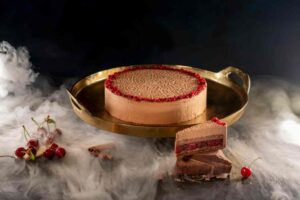
“Álmodozó” (Dreamer): Sugar-Free Cake of the Year
This competition, co-organized by the Hungarian Confectioners’ Guild and the Egy Csepp Figyelem (A Drop of Attention) Foundation, has been promoting diabetes-friendly baking for years, encouraging confectioners to create desserts that everyone can enjoy.
Kovács’ creation pulls off a remarkable magic trick—it tastes like a nostalgic Hungarian classic while breaking new ground. Drawing inspiration from beloved traditional cakes Lúdláb (“Goose Foot”) and Rigójancsi (named after a famous Hungarian gypsy violinist), the Dreamer combines a cocoa-almond sponge with cinnamon-infused sour cherry chia compote.
“The challenge is always finding natural sweetness without resorting to artificial substitutes,” Kovács shared. “The cocoa nibs provide both texture and a natural bitterness that balances the dish.”
The cake represents a growing trend in Hungarian confectionery—honoring traditions while adapting to contemporary dietary needs. For the one million Hungarians living with diabetes or prediabetes, it’s a welcome development that expands access to the nation’s rich dessert heritage.
Breaking Bread
While cakes often steal the spotlight, bread holds a special place in Hungarian culture. The Saint Stephen’s Day Bread Competition, now in its 14th year, celebrates this humble yet essential staple.
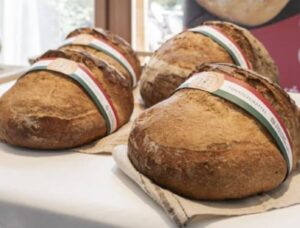
“Alföldi Pajta” (Great Plain Barn): Bread of the Year
This year’s champion came from the eastern Hungarian town of Balmazújváros, where Balmaz Sütöde bakery crafted the winning “Alföldi Pajta” (Great Plain Barn). This rustic spelt bread captures the essence of Hungary’s agricultural heartland—simple, nourishing, and rooted in tradition.
“Spelt has been grown in the Carpathian Basin for thousands of years,” explains the bakery’s master baker. “We’re not inventing something new; we’re reviving something ancient and making it relevant for today’s tables.”
The choice of spelt connects this modern creation to Hungary’s agricultural history. Long before wheat dominated European bread-making, spelt was the grain of choice throughout much of the region—hardier against harsh weather and naturally resistant to many pests. Its comeback in contemporary baking represents both culinary heritage and sustainable farming practices.
Meanwhile, Varga Pékség from Mórahalom took home the Innovative Bread Award with their Mediterranean-inspired creation. Featuring extra virgin olive oil, the loaf represents Hungary’s openness to culinary cross-pollination while maintaining its distinctive baking heritage.
Varga Pékség from Mórahalom won the Innovative Bread Award
Not to be outdone by the bread specialists, Három Tarka Macska (Three Colorful Cats) Bakery claimed victory in the pastry category with their “Augusztusi álom” (“August Dream”). This cherry and brownie-filled creation proves that Hungarian bakers excel at both the savory and the sweet.
A Culinary Heritage in Evolution
These competitions reveal something essential about Hungarian food culture—it values tradition while embracing innovation. In a country where food is intrinsically linked to national identity, these annual contests do more than crown winners; they chart the course of culinary evolution.
The Hungarian Confectioners’ Guild, founded in 1884 (coincidentally, the same year József Dobos created his famous cake), has been instrumental in preserving techniques while encouraging new expressions. Similarly, the Hungarian Bakers’ Association safeguards bread-making traditions that stretch back centuries.

The award ceremony is held in the Parliament
The significance of holding the award ceremony for Cake and Bread of Hungary in Parliament cannot be overstated. In Hungary, gastronomy isn’t just commerce or craft: it’s cultural heritage worthy of recognition in the halls of government. Few countries elevate their culinary traditions to such prominence, but for Hungarians, these foods represent national identity as surely as their flag or anthem.
Choosing Cake and Bread of Hungary every year serves another purpose beyond crowning winners—it documents and preserves Hungary’s culinary heritage while allowing it to breathe and evolve. Each winning recipe becomes part of an ongoing conversation between past and present, tradition and innovation.
For Hungarians, these foods represent more than just sustenance; they’re edible fragments of cultural memory, constantly refreshed through competitions like these. Each creation proves that Hungary’s gastronomic legacy remains vibrant, relevant, and deliciously alive in the modern world.
