
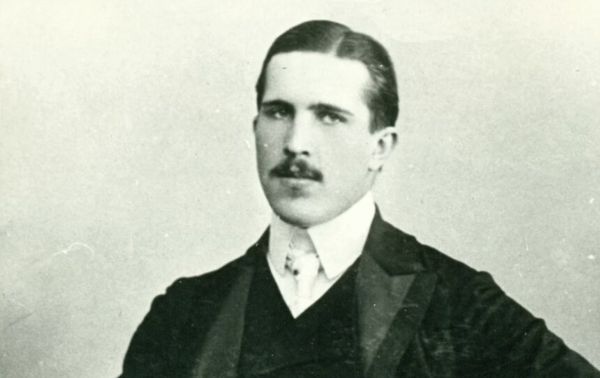
Some names outlive the people who carried them, and Károly Gundel belongs firmly in that category. He simply defined Hungarian gastronomy. Mention his surname anywhere in Budapest, and it conjures a whole world: white tablecloths in the City Park, a dessert that made pancakes famous, and a standard of hospitality that Hungary still measures itself against. But the man behind the legend was far more interesting than the brand suggests: a decorated wartime officer, a prolific writer, a father of many children, and above all a host who treated every guest as though they’d wandered into his own home.
Let me walk you through his story, because it’s one worth knowing.
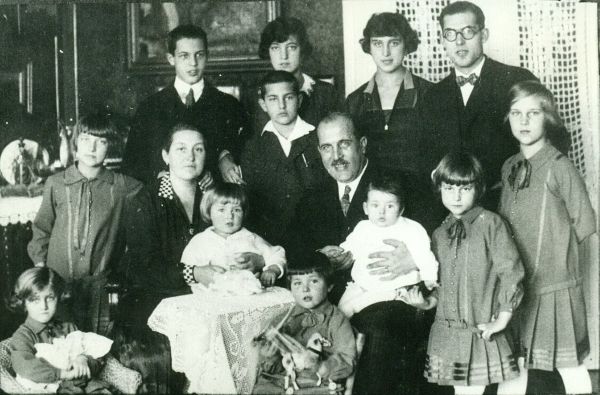
Károly Gundel with his family
Born Into the Trade
Gundel didn’t stumble into Hungarian gastronomy—he was raised inside it. Born in Budapest on 23 September 1883, he grew up watching a master at work. His father, János Gundel, owned the Erzsébet Királyné Hotel and later the István Főherczeg Hotel, and he’d made a name for himself in public life as well. That environment shaped Károly more than any school could.
He learned the business the way the best in the trade always have: from the bottom. Károly spent his “apprentice years” in his father’s hotel, working first as a piccolo and then as a bread boy—humble jobs that taught him how a great establishment actually runs, floor by floor. In 1900 he earned his diploma from the Budapest Commercial Academy, and from there he went abroad to sharpen his craft. In the hotels and restaurants of Switzerland, Germany, England, and France, he absorbed the finer points of the profession and gathered experience that would last a lifetime.
That international grounding matters. By the time he returned home, Gundel had seen how hospitality was done at the highest level across Europe—and he was ready to bring that standard to Hungarian soil.
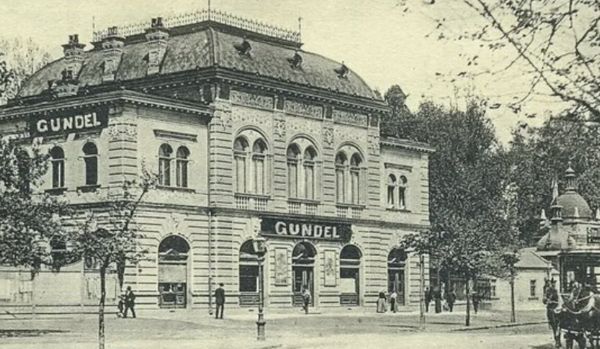
Old Gundel restaurant
From Wampetics to a Household Name
His path into management was steady and quick. In 1906, he became hotel secretary for the International Sleeping Car Company at its resorts near Lake Csorba and Tátralomnic. Within two years, he’d been promoted into the director’s chair. That trajectory tells you something about the man: he’d learned the trade from the ground up, and he rose fast.
In 1910, he moved his family to Budapest and took over the Wampetics restaurant, a garden establishment sitting right beside the Municipal Zoo in the City Park. He didn’t keep the old name for long. Renamed Gundel, the place became something close to an institution almost overnight. The reasons weren’t mysterious: intelligent, well-considered business decisions, a genuinely excellent kitchen, and service that operated on a level most competitors couldn’t touch.
The scale of the operation, once it hit its stride, is genuinely impressive. Thirteen cooks worked the kitchen preparing the dishes. Fifty-two waiters carried them to the tables. And a further forty staff members kept the whole enterprise running smoothly for the comfort of guests. Keeping with family tradition, several of Gundel’s thirteen children took part in running the restaurant themselves.
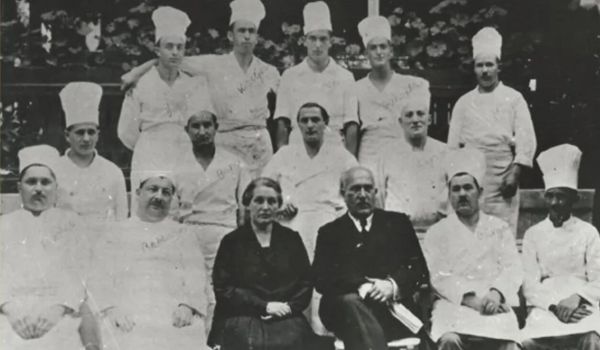
Gundel with his wife and team
A War That Shaped the Man
Here’s the part of his life that surprises most people. Long before he was celebrated as the face of Hungarian gastronomy, Károly Gundel fought as a reserve officer in the First World War—and not quietly. He was decorated multiple times for his service on the front lines.
While he was away, the restaurant survived on the strength of his family and a manager hired specifically for the war years. He came home in 1918, discharged with the rank of captain, and returned to his family and to the restaurant in the City Park. What greeted him was hardly encouraging. The post-war economy was brutal: shortages of food and fuel, rampant inflation, and a sharply reduced number of guests. He rebuilt anyway. That restaurant went on to become one of the most recognized dining establishments in all of Hungary.
The Golden Years
Through the 1920s and 1930s, Gundel didn’t just recover—he expanded. He took over the leasing of restaurants at the Royal Hotel between 1920 and roughly 1926, then the restaurants at the famous Gellért Hotel from 1927, holding that lease until 1948. Meanwhile, his own name was climbing toward international recognition, and he was fast becoming a leading figure in Hungarian gastronomy and tourism.
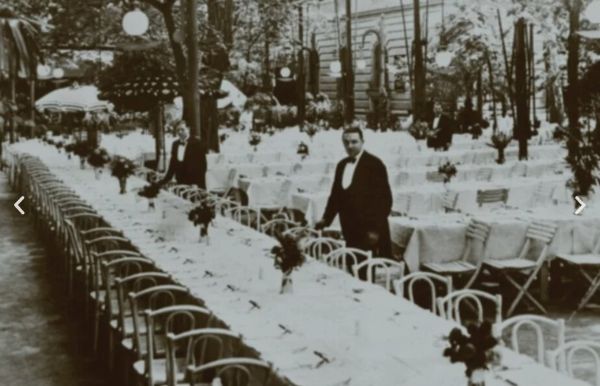
Old Gundel garden
The proof arrived in the form of prestigious commissions. When the Italian King Victor Emmanuel III visited Hungary in 1937, the government entrusted Gundel with organizing the state banquet at Székesfehérvár. Two years later, the Gundel restaurant served as the official restaurant of the Hungarian pavilion at the New York World’s Fair. The New York Times captured the impact in a line that still makes a marketer smile: “The Gundel restaurant provides bigger, better publicity for Budapest than a shipload of tourist brochures.”
What made the place magnetic wasn’t only the food. Gundel understood atmosphere. He hired musicians and singers, created secluded sections in the garden for private gatherings, and reserved a separate terrace for the cream of society. The journalist Zoltán Egyed summed up the restaurant’s grip on the city perfectly: “If someone wants to go not just for show but actually to eat well, people tend to say: let’s go to Gundel.”
Dishes That Traveled the World
You can still find Gundel’s culinary inventions on international menus today. Alongside traditional Hungarian and French dishes, the restaurant served creations that earned worldwide fame in their own right: fogas (pike-perch) Gundel-style, the Gundel tokány, veal chop Gundel-style, and salads bearing names like the Gellért, the Liget, and Gundel itself.
The crown, though, is unquestionably the Gundel pancake—an invention so celebrated it’s been called the “king of pancakes.” It’s a walnut filling enriched with candied orange peel, raisins, and cream, then served under a creamy chocolate sauce. Eating one is, quite simply, a genuine culinary pleasure. It’s the rare dish that has outlived its restaurant’s original era and gone fully global.
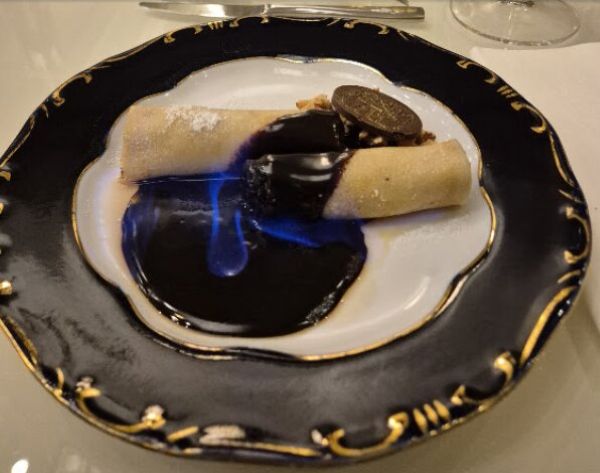
Famous Gundel palacsinta
Books That Shaped Hungarian Gastronomy
What sets Gundel apart from other great hoteliers is that he thought deeply about food and bothered to write it down. He promoted Hungarian cuisine through gastronomic books and essays, and his works rank among the best and best-known in the field. His major titles include The Art of Hospitality and The Craft of Hospitality, which distilled his professional experience, along with more scholarly efforts like The Development of Hungarian Cuisine and Hungarian Cookbook Literature Until the End of the 18th Century. His Little Hungarian Cookbook was a phenomenon—translated into several languages and running through more than thirty editions.
There’s a passage from The Art of Hospitality (1934) that reveals how seriously he took his mission. He argued that Hungary’s culinary past was a vast, unexplored area of cultural history—that fully understanding the nation’s heritage required studying its kitchen, eating habits, cooking superstitions, and table customs. Our cuisine, he wrote, differs from that of Western peoples much as our music and our language do—and not to Hungary’s disadvantage. Knowing all this, he insisted, was not merely interesting but useful.
He also had a democratic streak that feels strikingly modern. He believed the pleasures of the table often required only small things, provided they delivered genuine satisfaction. If we don’t only look upward, he suggested, if we see the everyday meals of ordinary people behind the “fine dining,” then we find the gastronomy that serves everyone’s joy.
The Legacy He Left Behind
Károly Gundel died in Budapest on 28 November 1956. His artistic sensibility ran in the family: several of his children distinguished themselves in hospitality, and among his grandchildren were the actors Zoltán Latinovits and István Bujtor, and the popular musician Károly Frenreisz.
His memory has proven durable. The Gundel restaurant in the City Park still bears his name, as does a vocational school for hospitality and tourism on Ecseri Road. Countless dishes, competitions, contests, and awards carry his name, and the Hungarian Museum of Commerce and Catering guards his material and written legacy with great care.
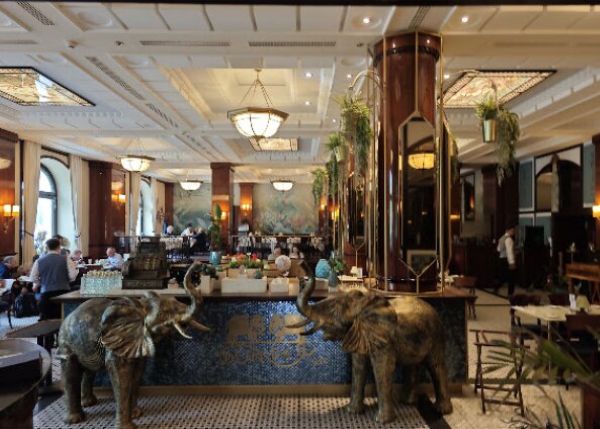
Gundel restaurant today
Perhaps the finest tribute came from the writer Andor Kellér, who identified the secret of his success in a single observation: Gundel greeted every guest with equal kindness—not with the stooping servility of a businessman chasing profit, but with the attentiveness of a host genuinely glad to welcome someone into his home. That, more than any recipe, is what made him unforgettable.
